Discover how LEED v5 certification is leading the way in construction sustainability. This updated version of the system LEED sets new standards in energy efficiency, water management, and indoor environmental quality, while prioritising the health and wellbeing of occupants. In this article, we will explore the key features of LEED v5 and its impact on creating buildings that are more environmentally friendly and healthier for those who inhabit them.
Principal features LEED v5
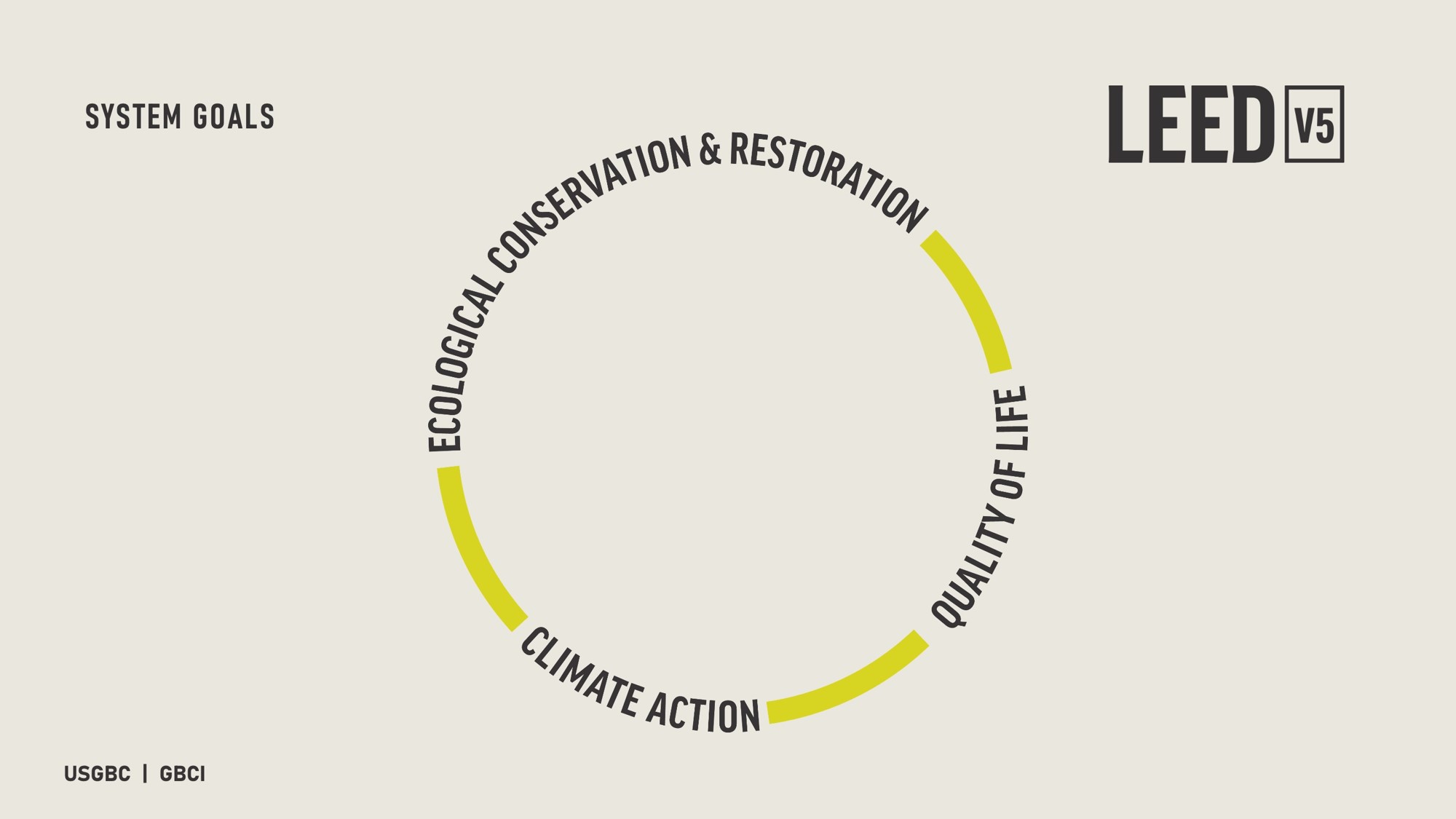
Source: U.S. Green Building Council.
LEED, by its English acronym Leadership in Energy and Environmental Design, is a globally recognised certification system that evaluates and ranks the sustainability of buildings. Version 5 of LEED, also known as LEED v5, is the latest update to this system; for now, only the beta version for Existing Buildings has been released. LEED EBOM. The three main objectives of this release are:
- Climate Action (50% points).
- Quality of Life (251 points).
- Ecological Conservation and Restoration (251 points).
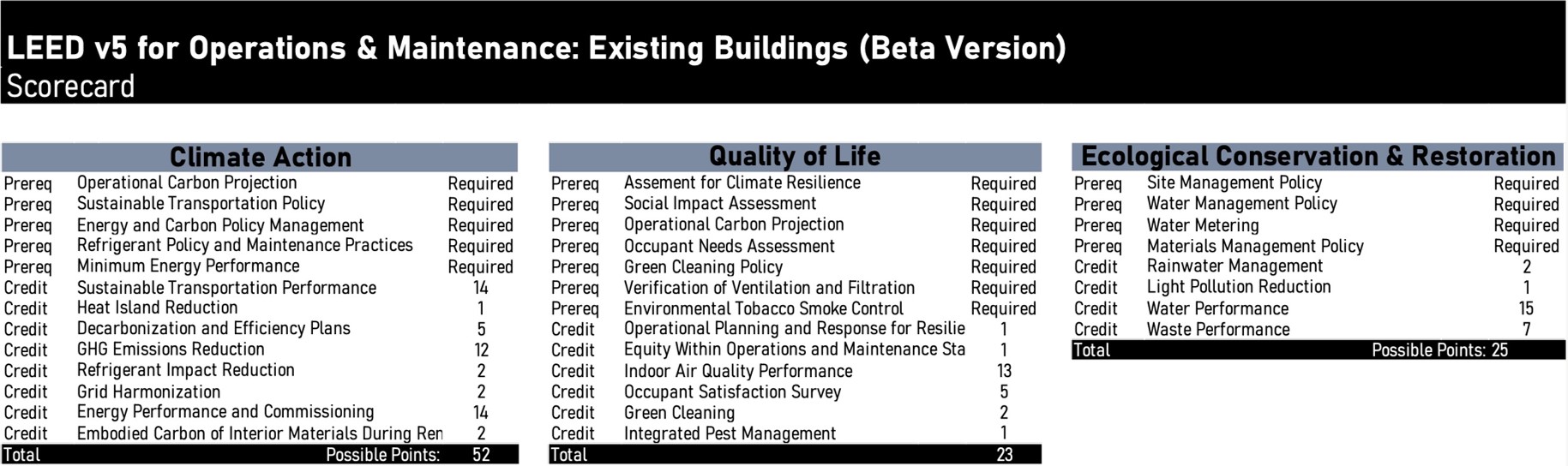
LEED v5 O+M prerequisites and credits broken down by main objectives. Source: U.S. Green Building Council.
Within the framework of these main objectives, version v5 lays down five principles:

Five LEED v5 principles. Source: U.S. GREEN BUILDING COUNCIL, edited by Evalore.
In many cases, this new approach to the system’s objectives (climate action, quality of life, ecological conservation and restoration) intersect or are interrelated with the five principles, meaning that this new v5 version represents a more holistic vision of LEED certification. With the decarbonisation of the construction sector being paramount, reducing emissions from existing buildings – that is, operational and embodied carbon – as well as preparing for climate disasters and adapting to climate change (climate resilience).
Buildings certified with LEED v5 are not only more environmentally friendly but also offer tangible benefits in terms of energy efficiency, reduced operating costs, and an improved quality of life for their occupants..
Differences of LEED v5 with previous versions
- New 3 prerequisites and 2 transversal credits
The objectives are set through 3 new mandatory prerequisites. Additionally, two cross-cutting credits are incorporated, meaning they do not belong to a specific category. However, they are visualised on the LEED scorecard within the Integrative Process category, now renamed Integrative Process, Planning & Assessments.

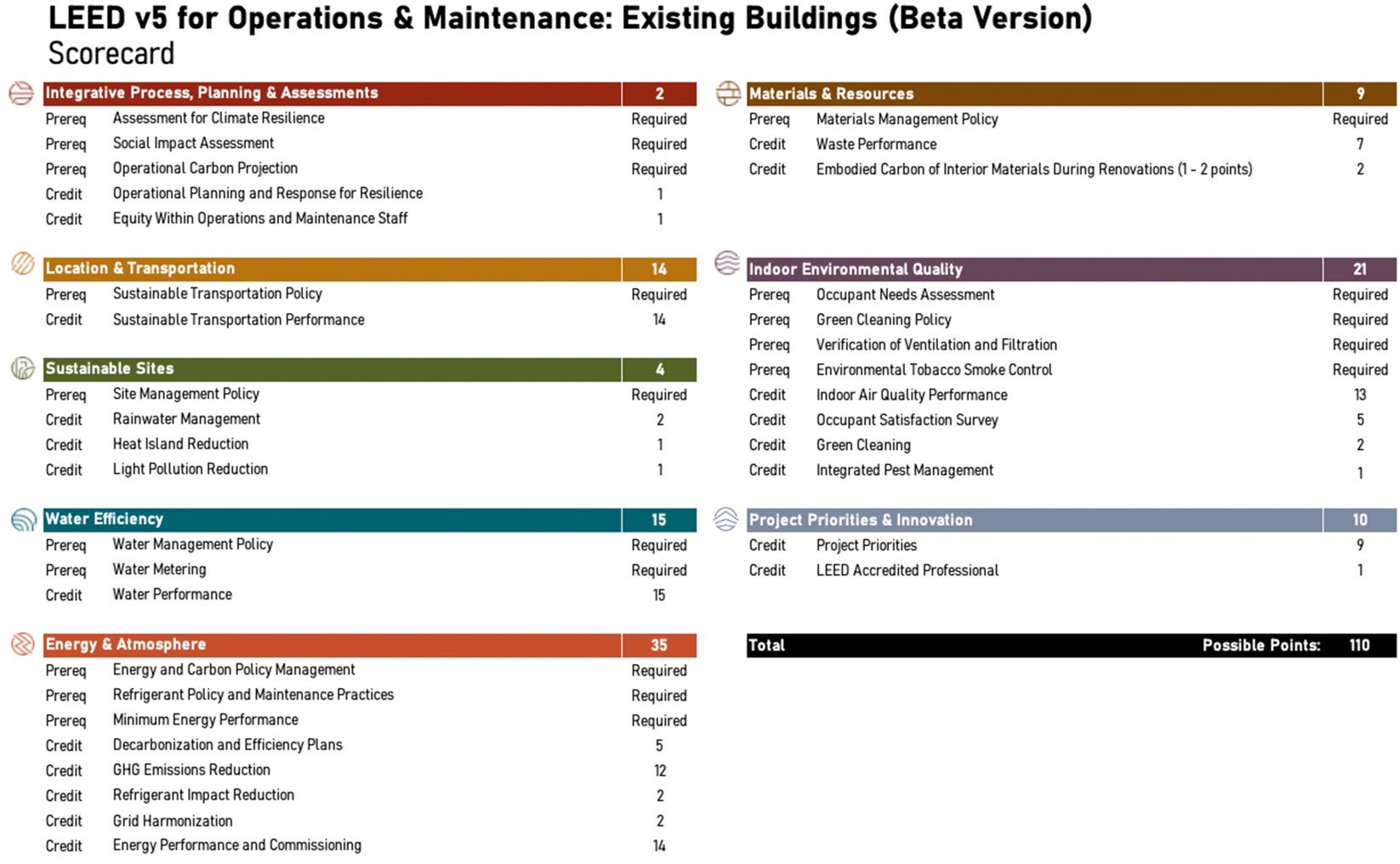
LEED v5 O+M prerequisites and credits broken down by traditional credit category. Source: U.S. GREEN BUILDING COUNCIL.
- Union of the categories Innovation and Regional Priority
Another difference compared to LEED v4 and earlier versions is the merging of the Innovation and Regional Priority categories into a single category, now renamed Project Priorities & Innovation, worth 10 points. This allows projects to select priorities focused on the project itself, rather than exclusively on regional priorities as has been done in previous versions (v4). In the Beta draft, the innovation subcategories include:
-
-
- Regional and local priorities
- Project type priorities
- Exemplary approach
- Pilot credits
- Innovative strategies
-
- Focus on Health and WellbeingLEED v5 has expanded its focus on the health and well-being of building occupants, incorporating new credits and requirements that prioritise indoor air quality, natural daylight, and other aspects related to human well-being.
- Mayor Rigour in Energy EfficiencyLEED v5 has established stricter standards for energy efficiency, incentivising practices and technologies that significantly reduce energy consumption and encourage the use of renewable sources.
- Focus on ResilienceLEED v5 has incorporated heightened attention towards resilience against natural disasters and extreme events, promoting design and construction practices that enhance buildings' capacity to withstand and recover from such occurrences.
- Greater Integration of TechnologyLEED v5 has integrated a greater number of smart technologies and systems into the certification, encouraging the implementation of automation and monitoring solutions that improve building performance and management.
- Emphasis on Continuous AssessmentLEED v5 promotes continuous assessment of building performance over time, not just at the time of initial certification. This ensures that buildings maintain high sustainability standards throughout their lifespan.
- Energy Performance ThresholdIt should be noted that the Energy Star energy performance benchmark changes with respect to previous versions, being 60 for v5. LEED v4 requires an Energy Star score of 75 (i.e., the 25th percentile among buildings of the same type). However, projects cannot earn energy points until they reach the benchmark of 69 (the only benchmark from the 2009 version).
- Rating SystemsTo date of publication of this blog, LEED O+M for Operations and Maintenance is the only system to be released with version 5., Beta programme. Below, the differences between prerequisites and credits for LEED O+M can be observed across the different versions: v5, v4.1, and v4.
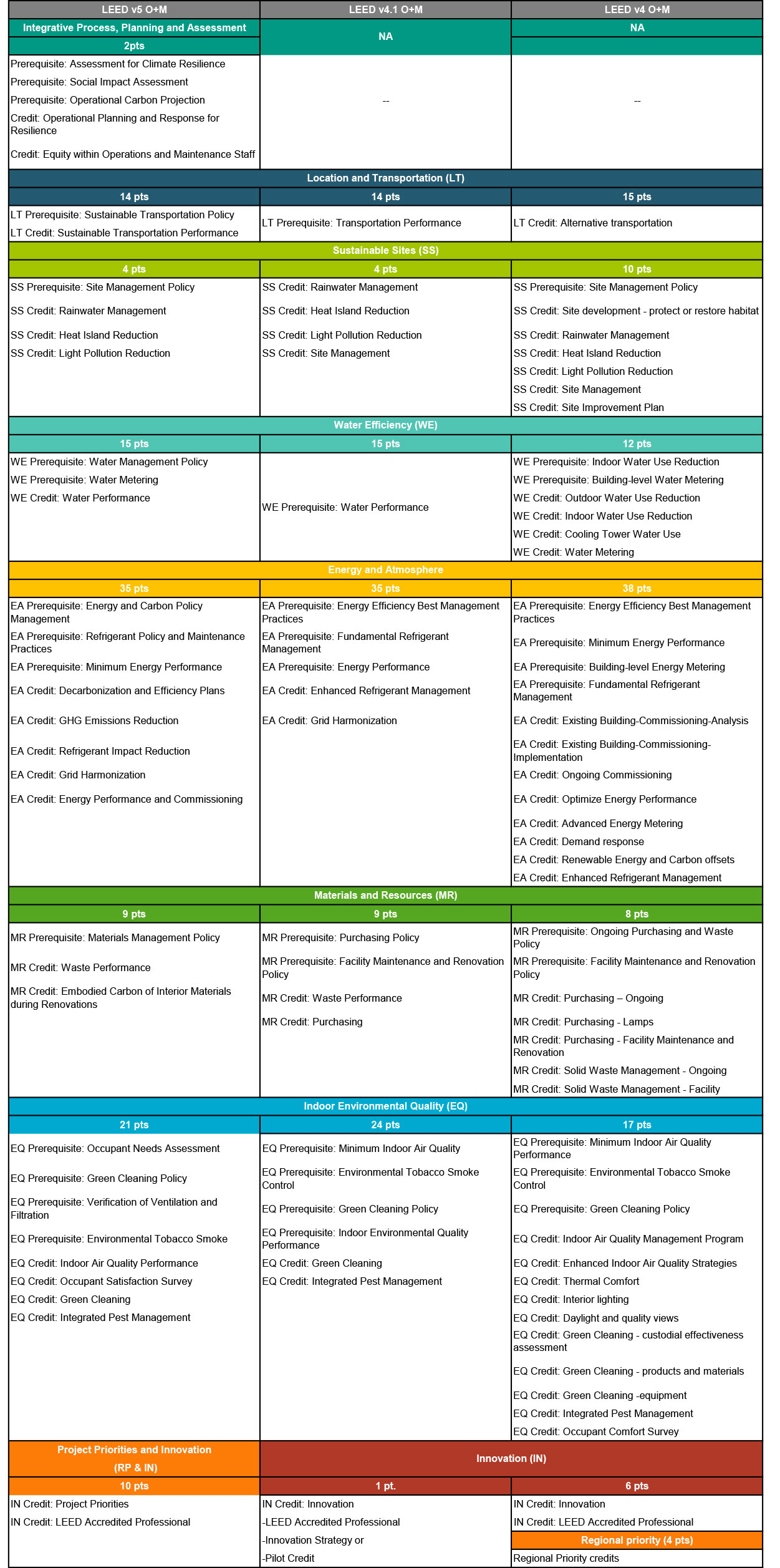
Differences in credits and scoring between LEED v5 – LEED v4 – LEED v4.1 Source: EVALORE
LEED v5 proposes continuous improvement as a certification element
What benefits does LEED v5 O+M offer compared to other available certifications?
The LEED v5 O+M standard offers different interconnected pathways to achieve certification, focusing on strategies and performance through a planning, implementation, and evaluation approach. This approach highlights the importance of establishing the most effective management practices, communicated through policies and assessments that support the process and guide direction. Below, we provide comparisons with respect to other sustainable certifications, such as BREEAM y WELL.
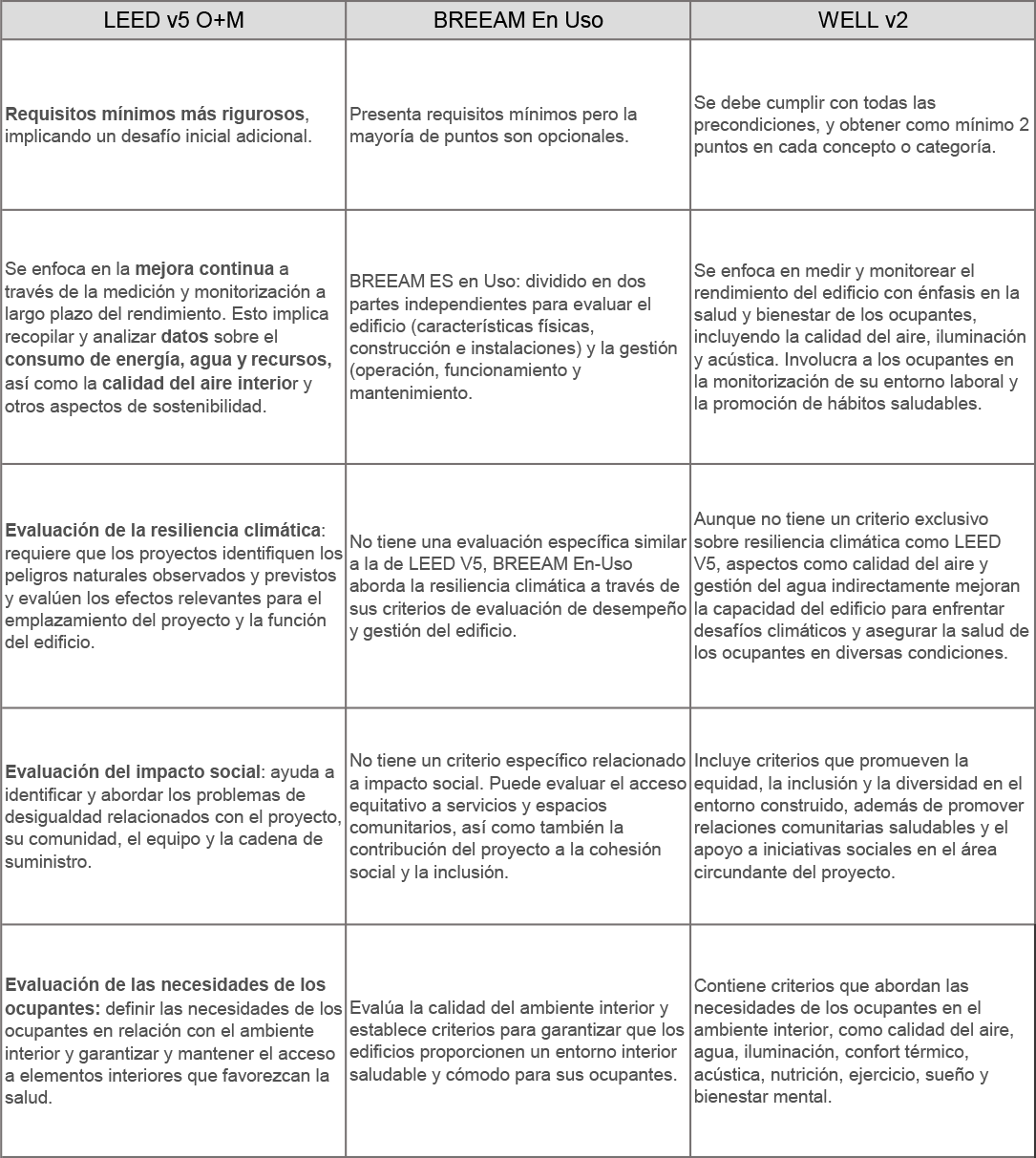
Source: EVALORE
How to obtain LEED v5 certification?
To obtain LEED v5 Certification, several steps must be followed:
- Register on the LEED online website and select the certification category «LEED v5 Existing Buildings: Operations and Maintenance» (EBOM).
- Prepare the documentation necessary for certification. All should be collected Relevant data about the building, as in energy and water consumption, the materials used, waste management, and so on.
- Initial assessment of the building to determine its current condition and potential for improvement. Credit assessment, which consists of selecting and documenting the credits you wish to obtain. Each credit has a specific value, and enough credits must be obtained to reach the minimum required score.
- Action plan detailed to address the areas for improvement identified in the initial assessment.
- Submit the certification request via the LEED website.
- The application will be reviewed by the U.S. Green Building Council (USGBC), who will verify that all necessary requirements and credits for certification are met.
- If the request meets all the requirements, it will be will be approved and issued LEED EBOM Certification with the achieved certification level.
Spaces Evaluate
We are committed to guiding our clients in improving their Projects and encourage your contribution to caring for the planet. Interested in discovering how we can support you? Don't hesitate to Contact us Right now.
LEED v5 It represents a milestone in the evolution of sustainable construction. With its renewed focus on health, energy efficiency, water management, and innovative design, this version is setting a higher standard for sustainability within the construction industry.
If you would like us to help you certify your building, please contact us.

Carolina Andrea Conte, LEED Green Associate
Architect and Sustainability Consultant, Espacios Evalore SLP

Laura Barrios Mogollón
Architect and Sustainability Consultant, Espacios Evalore SLP