The importance of caring for indoor air quality
As we were saying in our previous Blog post about WELL Certification, we spend around 90% of our lives indoors, where the air is between two and five times more polluted than the air outside. This statement, in a climate where news stories about air pollution in our cities are a daily occurrence, is extremely shocking, yet it has a very logical explanation: the composition of indoor air is based on that of outdoor air, but with the addition of all pollutants from indoor sources: radon, formaldehyde, VOCs, water vapour, etc. The following chart shows the most significant pollutants affecting indoor air quality and their sources within built environments.
Indoor air is 2 to 5 times more polluted than outdoor air. Wellness It is the most effective solution to alleviate this problem
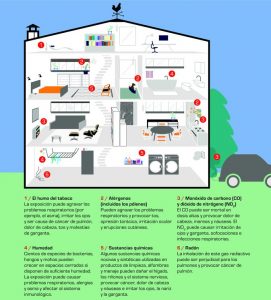
Source: Joint Research Centre of the European Commission
The problem of indoor air pollution is not to be taken lightly. Excessive pollutant concentration in the air can cause numerous illnesses, mainly respiratory such as lung cancer, but also cardiovascular, digestive and neurological ones, and, according to the World Health Organisation, it is the main cause of around 2 million deaths a year worldwide (classified as the tenth most significant preventable risk factor overall).
Indoor air pollution is the main cause of approximately 2 million deaths per year worldwide.
Outdoor air pollution
So much for the bad news. The good news is that numerous measures can be implemented to reverse this situation. For one, we must implement measures to improve outdoor air quality, which will undoubtedly have a positive impact on the air quality within our built environments. We have seen local policies aimed at temporarily reducing pollution in Madrid and Barcelona, and even in other smaller cities on the Iberian Peninsula, through the total or partial closure of city centres to traffic. However, these types of measures, while momentarily effective, are merely a sticking plaster on a deep wound. The solution to reducing outdoor air pollution lies in policies that establish ambitious maximums for the energy consumption of vehicles, buildings, and industry, and that favour the implementation of clean energy generation methods. These measures undoubtedly represent an initial cost for public administrations and businesses, but even greater is the cost of the consequences we have already begun to pay due to the poor air quality in our cities.
Indoor Air Pollution and WELL Certification
En todo caso, el objetivo de este post is none other than to raise awareness about the importance of improving the quality of the air we breathe in our indoor spaces, and to this end we will focus on the measures we can implement in our buildings that relate to the way we build and the suitability of spaces. The WELL Building Standard (or WELL Certification), approved by the International WELL Building Institute, the most prestigious international organisation for the implementation of health and well-being (or Wellness in English) in the built environment, dedicates 29 of its 100 measures to ensuring optimal air quality. Here are some of the most important measures:
6 measures to improve indoor air quality
Measure air pollution levels
It is difficult to control what is not known. That is why one of the first measures to implement will always be the measurement of pollutant levels in indoor spaces. Among the pollutants that must be measured are formaldehyde, VOCs (Volatile Organic Compounds), carbon monoxide, particulate matter (PM10 and PM2.5), ozone, and radon. Temperature and humidity must also be controlled as they can encourage the growth of pathogens such as mould, which causes numerous respiratory illnesses.
2. Optimise ventilation
Indoor air renewal gets rid of indoor pollutants by introducing outdoor air. External pollutants such as particulate matter (PM10 and PM2.5), bacteria, mould, or smoke can be avoided by using high-efficiency filters (EU7 or their American equivalent MERV13 and above) in ventilation systems. Ventilation also prevents humidity build-up and, with it, condensation issues that cause pathogens like mould and material deterioration. However, the ventilation volume must be optimised according to the needs of each building, as greater air exchange also leads to higher energy demand, which can be limited by installing heat recovery units (this is a topic that requires a post exclusive and will be addressed later). For those spaces that do not have a mechanical ventilation system in cities where outdoor air quality is a problem, it is recommended to check the outdoor air quality before opening windows, as pollution levels vary from day to day. In office spaces, for example, it is possible to automate windows so that a light indicates whether or not it is advisable to open them at that precise moment. The information can be obtained from external sensors or nearby monitoring stations. Real-time information can be found on the websites of Madrid and Barcelona city councils.
Information website of the Real-time air quality in Madrid:
http://www.mambiente.munimadrid.es/sica/scripts/index.php
Information website of the Real-time air quality in Barcelona:
http://ajuntament.barcelona.cat/qualitataire/es/
3. Eradicate tobacco from buildings
The health problems caused by inhaling tobacco smoke are well-known, both for smokers and for non-smokers who share spaces where smoking is permitted. For optimal indoor air quality, tobacco should be eliminated not only inside buildings but also in the vicinity of entrances. Due to the chimney effect in multi-story buildings, air enters lower floors and exits upper floors through pressure variations. To prevent tobacco smoke from entering, it is important that smoking is not permitted within 7.5 metres of building entrances. Furthermore, due to the relatively high degree of air infiltration between different spaces within the same building, it is important that the anti-smoking policy affects the entire building.
4. Use healthy cleaning products
The most common cleaning products often contain chemicals that are harmful to health. The use of non-toxic and hypoallergenic cleaning products and materials helps to improve indoor air quality and reduce the occurrence of pests, environmental allergens, and unpleasant odours. Furthermore, it is advisable to establish a cleaning protocol that dictates the frequency and manner in which each surface should be cleaned. For surfaces with high contact frequency (door handles, light switches, etc.), the use of advanced cleaning methods for bacteria elimination, such as ultraviolet light devices, is recommended.
5. Use healthy building materials and methods
There are numerous construction materials that release harmful substances into the air throughout their lifespan. These include wood-based products which sometimes contain formaldehyde; sealants, adhesives, and paints that often contain VOCs; or carpets and rugs that accumulate dust, which is subsequently emitted as particulate matter. These same materials can be found in furniture and building elements. It is advisable to assess the composition of materials before their use and to include certified products with sustainability labels (such as Greenseal or Greenguard) whenever possible. Regarding paints, photocatalytic paints can be used which, through a photocatalysis process, help eliminate pathogens and unpleasant odours. Furthermore, the construction method itself can be optimised to improve future indoor air quality: by establishing a specific material installation protocol to minimise porous materials absorbing substances that can subsequently be released; by sealing the air inlet and outlet points of ventilation and air conditioning systems during construction to prevent pollutants from entering them; and by carrying out thorough sealing of partitions and other compartmental elements to prevent the infiltration of poorer quality air from adjacent spaces.
6. Install advanced air purification systems
Certain spaces, either due to their nature requiring excellent air quality (hospitals, laboratories, etc.), or due to circumstances involving excessive pollutants (proximity to busy roads, factories, etc.), may require the installation of advanced air purification devices. These devices can be incorporated into the ventilation system in spaces that have a mechanical ventilation system, or be installed as independent units. Among the main methods used for air purification are activated carbon and active polarisation filters, ultraviolet radiation systems, and photocatalytic oxidation systems.
Take the step, improve the quality of the air you breathe
Currently, there are 35 buildings certified by the WELL Building Standard and over 500 in the process of certification that have implemented measures such as those mentioned previously to improve indoor air quality.
In Spaces Evaluate We have developed a proprietary method based on WELL Certification for the implementation of all types of measures Wellness, including those related to air quality optimisation. Our method is affordable for all businesses and tailored according to the client's budget, and the impact and feasibility of each measure in the space in question. If you want to improve the indoor air quality you breathe and implement a series of health and well-being measures for your space, do not hesitate to contact us and we will provide you with a Free diagnosis.

Pablo Muñoz, CPHD, LEED GA, BPI MFBA
Co-founder and CEO of Espacios Evalore SLP