Introduction
If your asset is a building that is let out, WELL Core is the only Health and well-being framework what can be translated into Best economic performance of the asset, both in rents and installments, and with less risk in operations and marketing.
WELL Core acts as WELL's pathway for the «base building» when the owner and the regular occupants are different. That is, when the owner.
1. What is WELL Core and how does it differ from WELL Standard
WELL Core focuses on what the property owner or manager controls, that is, common areas, systems, specifications, and base conditions. It is designed for projects where a large part of the building is leased and, therefore, control over tenant spaces is partial.
Instead, the WELL Standard, which is the “complete” WELL certification, fits best when there is broad control over the interior and operation of the space. For example, a corporate headquarters or a space where there is an occupant-owner relationship.
The difference stems from control, scope, and applicability. This WELL modality recognises that reality and defines how are requirements applied in a base building opposite leased spaces.
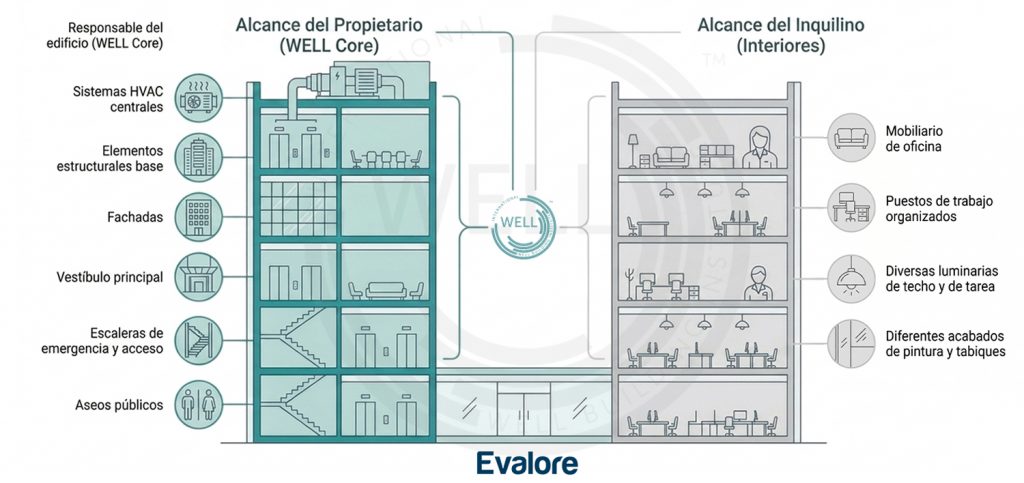
Scope of WELL Core. Source: Evaluate (own elaboration)
2. WELL Core modalities
Multi-tenant buildingSeveral tenants): WELL Core certification may be applied for if at least 75% of the project area is occupied by one or more tenants and/or is communal space accessible to tenants.
Mixed-use building Well established specific criteria; for example, it is stated that at least 60% of the area must be occupied by one or more tenants. If WELL Core applies to less than 60%, it is recommended that portions be registered as individual projects, as appropriate.
Single-tenant (100% leased to a single tenant): There are specific guidelines when the building is let to 100% to a sole tenant and the operation or maintenance is transferred to the tenant.
3. Key Aspects of WELL Core
Minimum scoreA WELL Core project must meet all preconditions and achieve a combination of optimizations to reach minimum 40 points.
Verification: This WELL standard requires that at least 2.5% of the total area be available for the Verification (measurements and visual inspection). It must include all communal areas and areas under the control of the building owner/manager. If these areas do not reach 2.5%, they are supplemented with tenants’ areas to reach the threshold.
Operating strategyWELL Core necessitates programming from the outset how access will be coordinated for the final verification, under what basic conditions they are handed over to the tenant, and what is incorporated into rental/operation clauses to stipulate clear responsibilities and avoid last-minute improvisation.
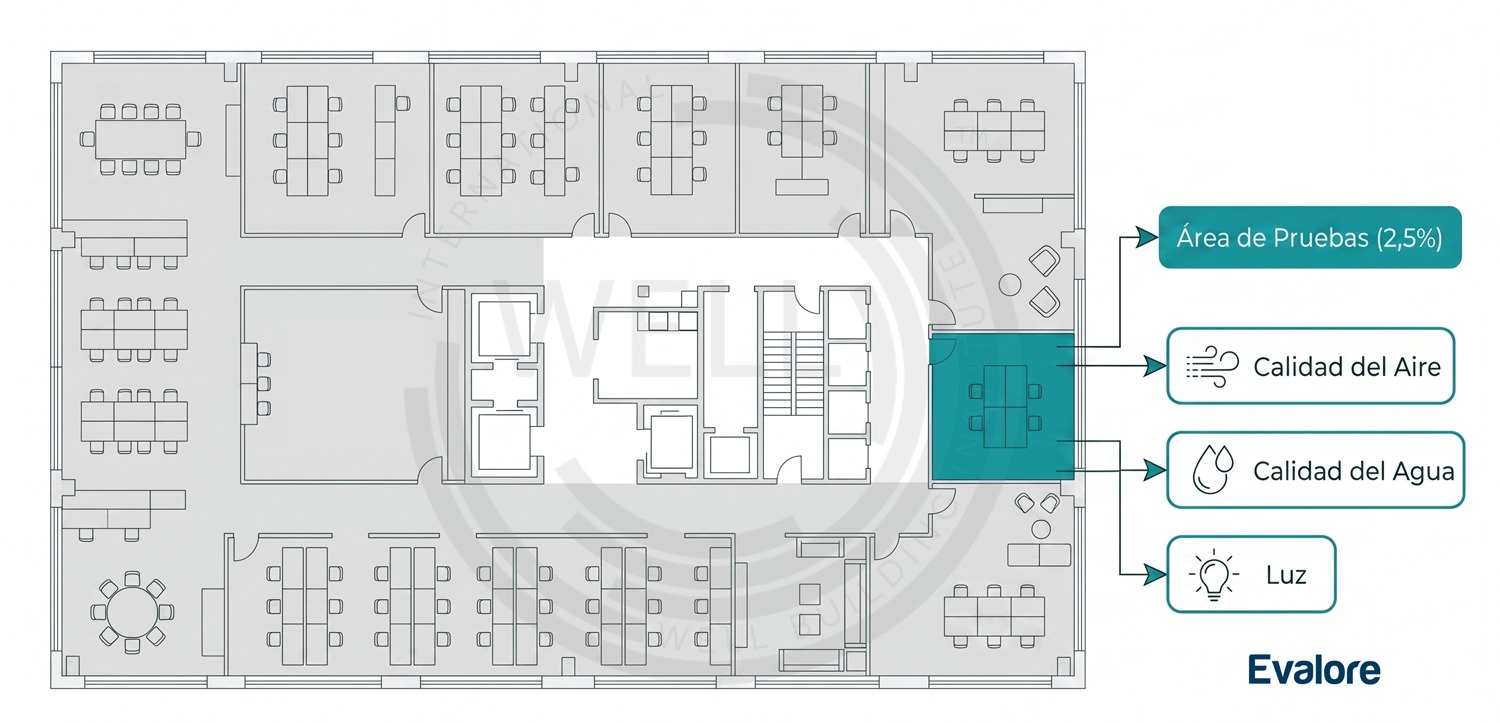
Minimum area for WELL Core measurement. Source: Evaluate (own analysis))
4. Economic benefits of WELL Core
Rental premium (quantitative evidence): the MIT Real Estate Innovation Lab It found that buildings with “healthy” certification had effective rents between 4.4% and 7.7% higher per square foot, compared with nearby non-certified/unregistered buildings, after controlling for other factors.
Longer rental terms (income stability): en market research disclosed by IWBI based on MIT research, longer lease terms are cited: 88.3 months vs 75.3 months (13 months longer).
Better commercial positioningBeyond the premium, the value of real estate typically lies in reducing uncertainty, making assets comparable and defensible for tenants with ESG policies, and in more demanding purchasing processes.
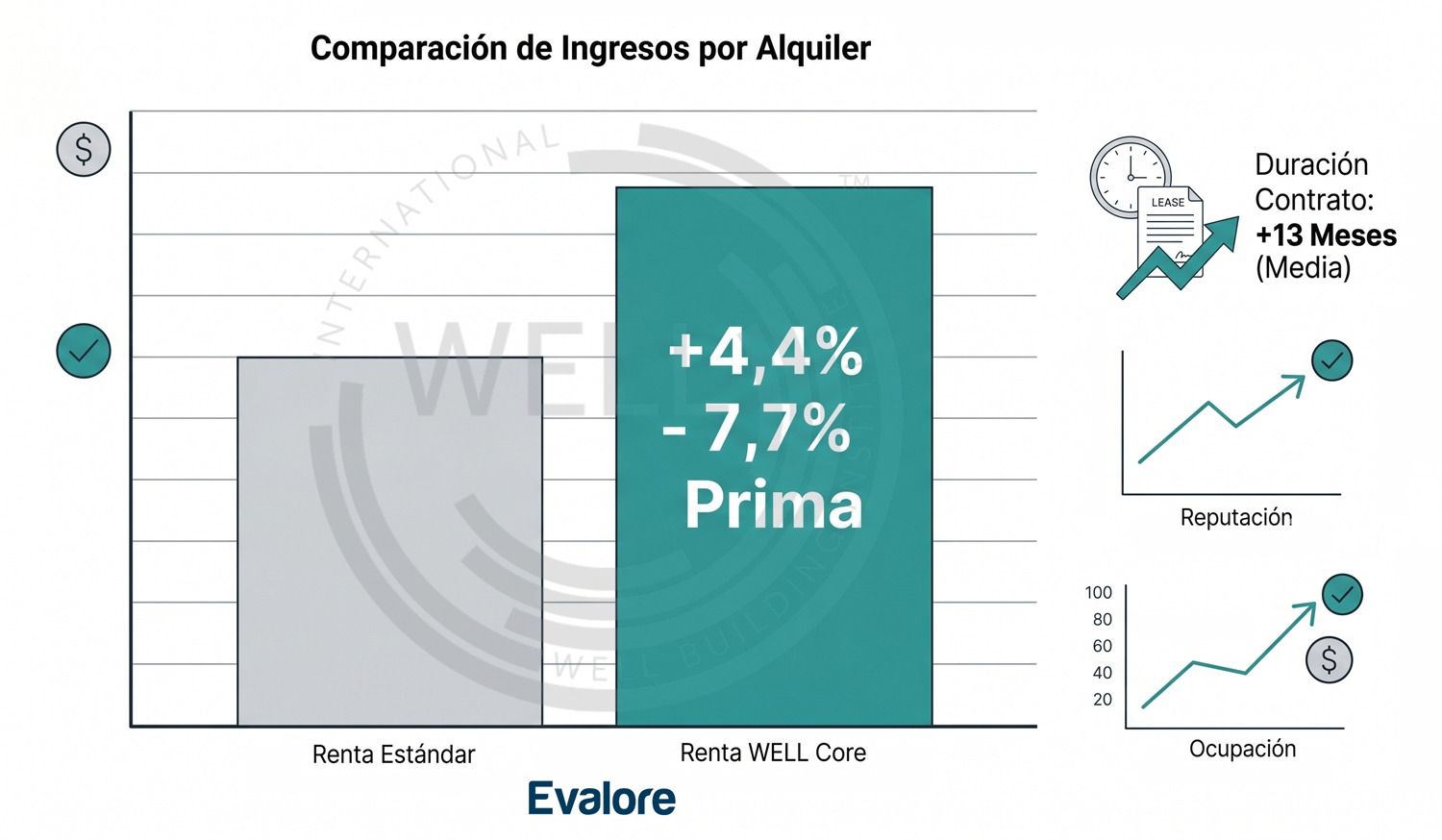
Economic benefits of WELL Core. Source: Evaluate (own analysis))
5. Benefits for people's well-being
One study published in Building and Environment (pre- and post-occupancy assessments across multiple offices) found improvements in WELL-certified buildings, including: 30% in satisfaction, 26% in perceived wellbeing, 10% in reported mental health and 10 points (median) in perceived productivity.
These studies are not a clinical guarantee, but evidence of improved perceived experience, which impacts retention, reputation, and productive consistency of individuals.
6. Frequently Asked Questions (FAQ)
When is WELL Core suitable and when is WELL Standard suitable?
It is usually the natural option for primarily leased buildings (base buildings). The WELL Standard is a better fit when there is broad control over the interior and operation of the space.
What is the minimum to certify WELL Core?
Meet prerequisites and reach at least 40 points with optimisations.
What happens if my communal areas do not amount to 2.5% of the total area?
Tenant spaces should be included to meet the minimum available area for on-site measurements and inspection.
What percentage leased does WELL Core require?
General rule: ≥75% of the area occupied by tenants and/or communal areas accessible to tenants. In mixed-use developments: ≥60%.
Can the WELL Core certification be achieved in a 100% building let to a single tenant?
Yes. There is specific guidance for that scenario.
What usually creates the most friction in WELL Core?
Coordination of access and responsibilities with tenants, particularly for verification purposes. It is therefore recommended that the scope and the 2.5% test area be planned from the outset.
Does it align with other certifications (LEED/BREEAM, etc.)?
Yes. It can be combined with LEED, BREEAM and other certifications. To ensure it doesn't become “extra work”, the important thing is to coordinate requirements and evidence from the outset, so that the same document or essay can serve multiple schemes where possible. This usually reduces management time and the volume of documentation.
7. How does Evalore accompany you?
In Evaluate We convert WELL Core certification into a controllable process that reduces uncertainties in deadlines, changes, and additional works that can lead to cost overruns in the project.
If you want us to help you certify your building, contact with us.

Israel Leal Las Vegas
Sustainability Consultant, WELL AP and BREEAM International Assessor, Espacios Evalore SLP