The WELL Challenge
Even though obtaining the WELL Certification it is a relevant milestone for any asset, Maintaining WELL over time is the real challenge operational because The certification doesn't maintain itself.
Many organisations get through the initial certification phase successfully, but then comes the less visible part of the process: reviewing expiry dates, coordinating measurements, updating evidence, documenting changes to the building, and preparing in advance for recertification.
When this is not ordered from the outset, WELL ceases to be perceived as a clear strategy and starts to feel like an administrative burden.
The reality is that WELL is not conceived as a static label. In WELL projects, certain strategies require periodic monitoring and reporting.
Furthermore, the certification must undergo recertification to verify that the space continues to function as designed and certified.
What does maintaining WELL Certification involve
To talk about WELL maintenance is to talk about continuity. It's not enough to have done it once. because WELL requires demonstration that the conditions, policies, and strategies that supported the certification remain active, current, and properly documented.
In practice, this usually involves four simultaneous work fronts:
- Track requirements that demand periodic reports.
- Retain maintenance evidence, protocols, and operational policies.
- Record any changes that may affect the scope or compliance of the project.
- Prepare the documentation and measurements in advance, which will be reviewed again during recertification.
When there is no adequate support, maintenance can represent a management problem as information is scattered between property management, facility management, human resources, purchasing, maintenance and external suppliers.
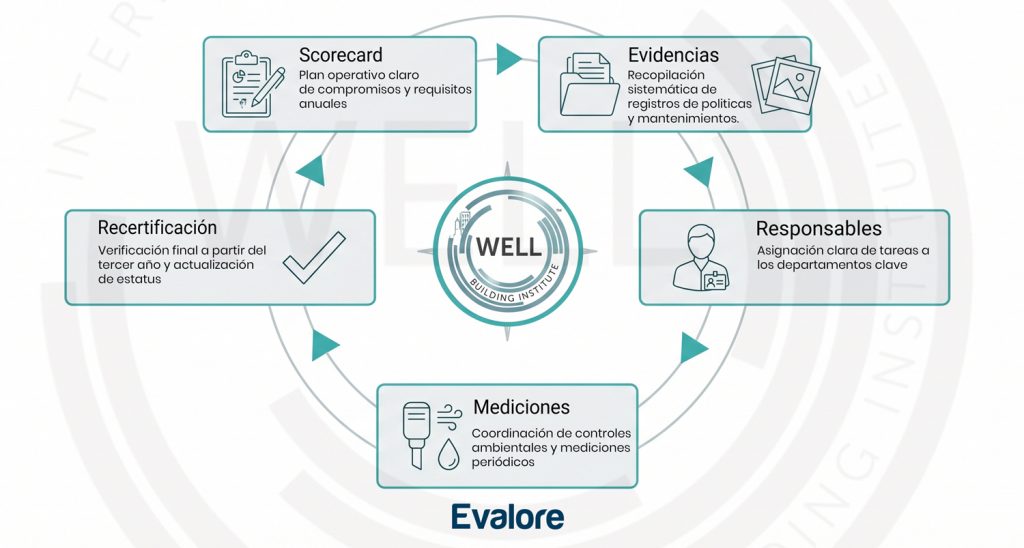
WELL Maintenance Process. Source: Evalore (own elaboration)
2. What should be reviewed each year for WELL maintenance
The continuous reports must be renewed every 12 months from initial certification. Depending on the credits the building has earned, this may include:
- Preventive and corrective maintenance records.
- Evidence of cleaning and replacement of filters.
- Environmental monitoring information or periodic inspection results.
- Surveys, communications or operational compliance documents.
- Review of changes to the design or use of space.
3. What happens as WELL recertification approaches
The project must submit the application for recertification How maximum of three years after the initial certification date. If done within the timeframe, validity is extended by 12 months while the process is completed. The scope of the new measurements depends on the alterations made.
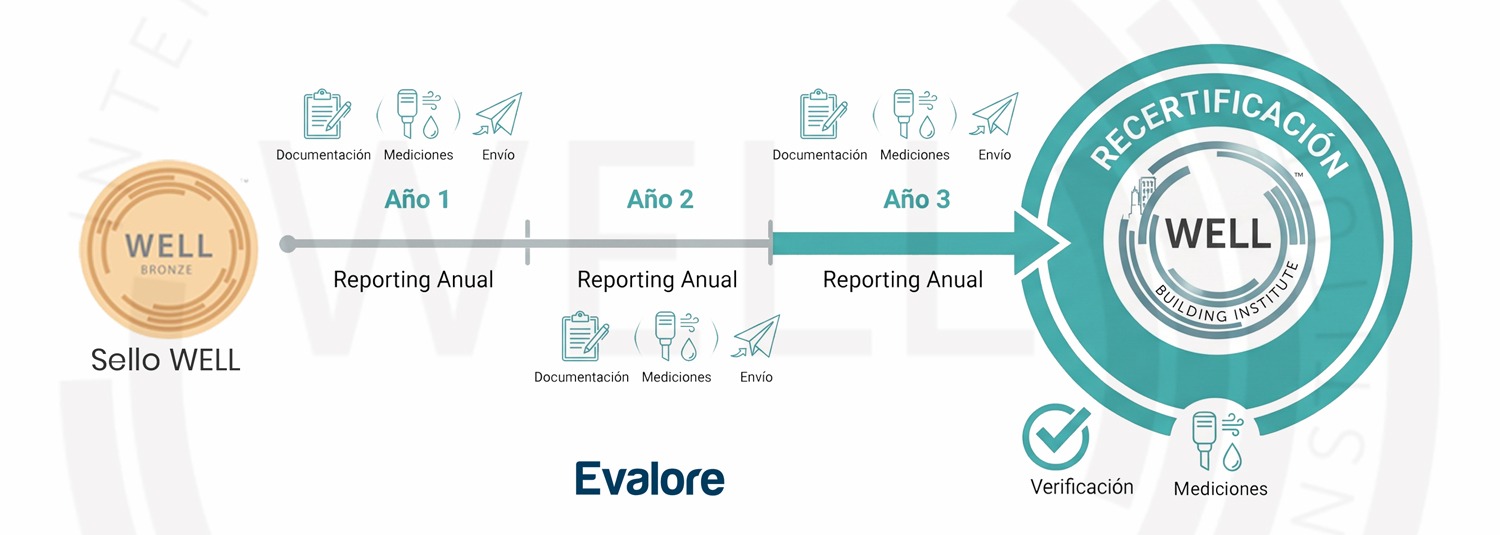
WELL Certification Maintenance Timeline. Source: Evaluate (own analysis))
4. What are the common problems in the WELL maintenance and recertification process
When WELL is left in the background, without attention or direction, recurring issues tend to arise:
- Hasty preparations before the imminent expiry.
- Scattered evidence between departments and suppliers.
- Unclear responsibilities for document production.
- Measurements requested late or without room to react.
- Changes to space that are not registered at the time.
5. Frequently asked questions (FAQ)
Every three years
At most, every three years from the initial certification.
What happens if the project submits the application within the deadline?
The validity extends for 12 months while the process is being completed.
Does recertification always require repeating all the tests?
Not necessarily. It depends on the changes that have occurred. If there are no substantial alterations, the scope can be reduced.
Can a consultancy company manage the coordination of certification maintenance?
Yes. Specialist support like Evalore's can organise documentation, deadlines, measurements, project changes and recertification preparation, reducing the burden on the internal team.
6. How does Evalore support you
In Evaluate We help owners, operators, and management teams to structure WELL maintenance, coordinate necessary documentation, plan measurements, and prepare for recertification with advance notice, clarity, and less burden on the internal team.
If your asset already has WELL Certification, the next step is not just to preserve it but to maintain it.
If you want us to review the status of your project and help you organise WELL certification maintenance, contact with us.

Israel Leal Las Vegas
Sustainability Consultant, WELL AP and BREEAM International Assessor, Espacios Evalore SLP